
Kurt von Hammerstein-Equord was a German general who served as Chief of the Army Command in the early 1930s. He was an unusual figure—an aristocrat who openly despised the Nazis, going so far as to call them a “criminal gang” before it was in vogue.
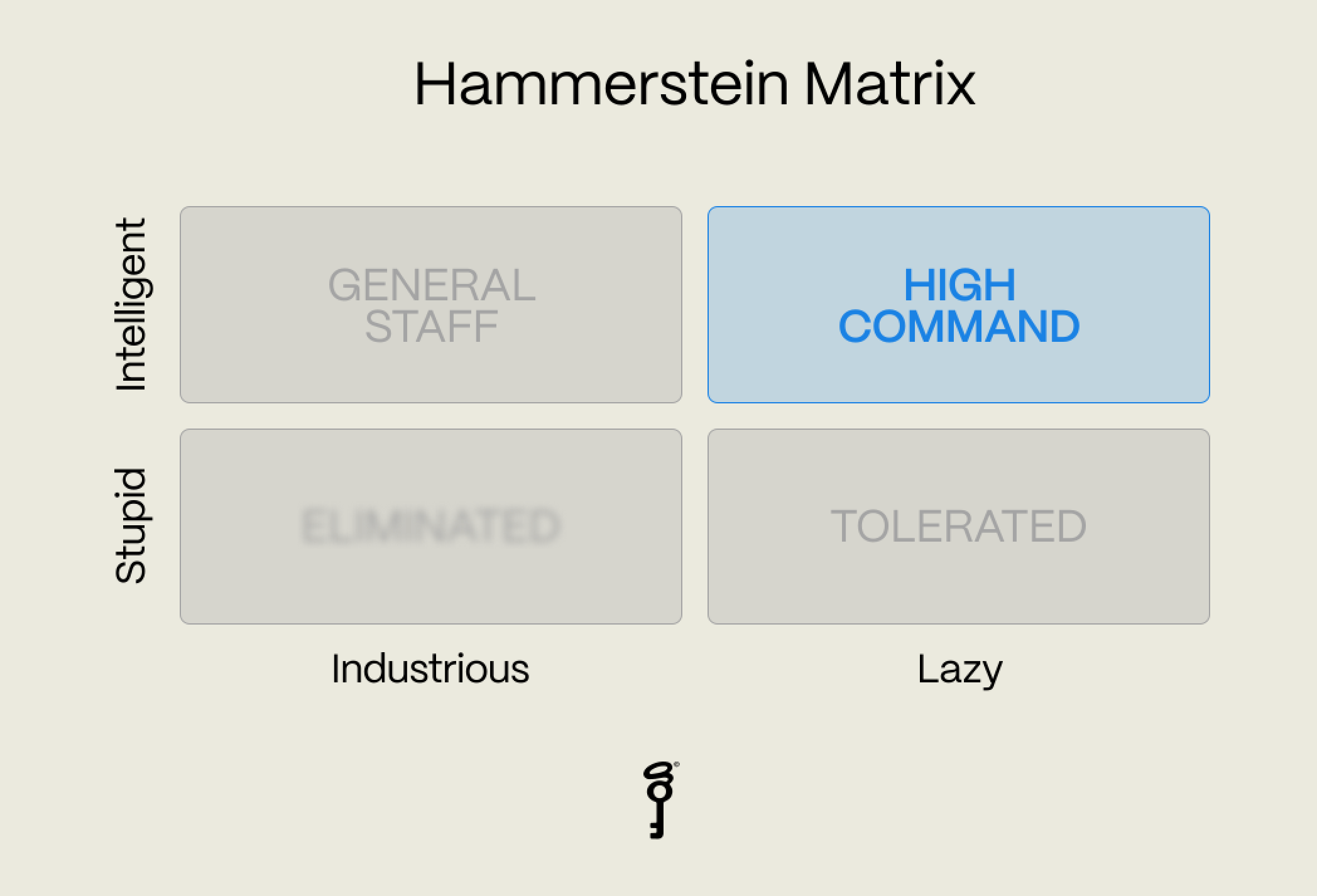
In 1933, Hammerstein articulated a method for evaluating officers. He classified them on two axes: intelligence and energy.
He assigned the intelligent and the industrious to the General Staff—excellent planners, tireless executors. The stupid and lazy he tolerated—they handled routine duties without causing harm. The stupid and the industrious he eliminated—they’d create problems faster than anyone could solve. The intelligent and the lazy won high command.
Hard work earned a staff position. Laziness earned the head of it.
Every venture investor faces a similar classification problem. Which founder cuts through complexity? Which one burns capital on problems that don’t matter?
A resume can’t tell you. A pitch deck can’t tell you. The Stanford MBA and the state-school dropout look different on paper. In the Hammerstein matrix, they’re indistinguishable.
So how do you know?
Mathematician Nassim Taleb offers what seems like an answer. He calls it the inverse heuristic: if two people achieve equal outcomes but one had every advantage and the other had none, the one without advantages must be better. They succeeded despite the headwind; the other succeeded with the tailwind.
His example is doctors. Imagine two surgeons with identical success rates. One is polished—crisp white coat, prestigious residency, diploma from a top medical school mounted on the wall. The other is a slob—unkempt, mustard-stained white coat, technically trained but socially graceless, no pedigree worth mention.
Taleb would advise us to choose the slob.
According to him, the polished doctor had every systemic advantage. Referrals came easier. Patients trusted the presentation. The slob had to overcome all of that just to stay even. Equal outcomes, unequal inputs—so the underlying skill must be unequal too. The slob is the better surgeon precisely because nothing about their appearance suggests it.
It’s a seductive heuristic. It flatters the contrarian. It rewards the pattern-breakers.
Applied to founders, the logic seems to transfer well: fund the dropout, not the MBA. The dropout had no safety net, no credential signaling competence, no warm intro from a well-connected professor. If they got this far, they must be exceptional.
But this inverts one shortcut with another. The slob doctor heuristic requires visible outcomes. At pre-seed, there are none.
So, what do you use instead?
Most investor conversations begin the same way: “Tell me about yourself.”
The founder shifts into pitch mode. Investors shift into evaluation mode. For the next thirty minutes, you watch a performance—polished, rehearsed, optimized for the context. You learn nothing you couldn’t have read in a memo.
That is what John Stuart Mill called intellectus sibi permissus—the mind left to itself. Most founders carry assumptions that they’ve never examined. They think and talk in certainties that feel solid but have nothing behind them. Most investors leave these untouched; why create conflict? So they evaluate the pitch, rather than the person.
Most investors ask founders what they believe. The question that reveals the Hammerstein quadrant is different: what evidence do you have for believing it?
A founder I spoke with recently believed he needed more experience before starting a company. He kept returning to it—he should work at a larger firm first, build “foundational knowledge,” wait until he was ready.
I didn’t argue. Instead, I asked: “What evidence do you have to believe that to be true?”
Long pause.
“I guess I have very little evidence.”
“So if you have very little evidence, what’s the conclusion?”
Another pause. Then: “That I should be working on big stuff.”
He arrived at it himself—a mind left not to itself.
This is the Hammerstein filter in action. The intelligent and lazy, when asked for evidence, realize that the belief doesn’t hold—and pivot. The intelligent and industrious reason through it methodically but get there. The stupid and lazy shrug, deflect, change the subject. The stupid and industrious double down. They manufacture justifications. They defend the belief rather than subtract their ego from it.
Credentials in and of themselves can’t tell you which founder you are facing. But how someone responds when you challenge the evidence behind an unexamined assumption, reveals.
But this method extracts something from you. To hold up a mirror for others, you must first turn it on yourself. The investor who hasn’t examined their own assumptions can’t surface anyone else’s. You cannot draw out depth you haven’t cultivated.
You can’t separate the builder from the building, the investor from the investing. The builder can only build as far as they’ve grown. The investor can only see as far as they’ve looked inward.